 Pencilsprotocol
Pencilsprotocol funded legacy deposit rewards with interest from vault borrowing
Pencilsprotocol directed interest from leveraged vault borrowing into the Staking deposit pool to fund depositor rewards. Vault users borrowed capital for liquidity-provider positions, while depositors supplied the pool that financed those positions. The deposit annual percentage rate, or APR, varied with pool utilization during legacy operation. Active deposit yields later ended during the 2025 transition to Dapylon, so this interest flow explained the earlier system rather than a current earning opportunity.
Who Received the Interest From Legacy Vault Loans?
Depositors received income from borrower interest through the Staking deposit pool during the legacy platform’s operating period. Vault borrowing carried a financing cost, and the pool used that interest to reward the people supplying its liquidity.
Borrowed principal supplied capital for the leveraged position; interest paid for the use of that capital. A loan balance therefore described financing, not the income that depositors earned.
Borrowed Capital Inside Vaults 1.0
The Vaults 1.0 design linked the vault pool to a decentralized exchange, or DEX, liquidity pool on Scroll. Users selected liquidity-provider (LP) tokens and a leverage multiple for their positions. The vault contract automatically sourced the required leverage funding from the Staking deposit pool. The DEX pool supplied the setting for liquidity deployment, while the deposit pool supplied financing.
The DEX pool issued LP tokens after receiving assets for the liquidity position. The vault staked those LP tokens to earn rewards.
How Did Pool Utilization Affect Deposit APR?
The legacy deposit APR model increased rates when borrowers used a larger share of the deposit pool’s funds. When borrowing demand weakened and more funds remained available, the model reduced rates. This floating-rate design linked deposit returns to liquidity demand within the pool.
Utilization described the proportion of pool funds that borrowers used. It differed from a vault’s leverage multiple, which described the scale of a position relative to its own capital. A large individual position did not reveal how much liquidity remained across the pool.
Low utilization lowered deposit APR while the pool operated. The later cessation of active yields represented a different state: the platform had ended active earnings on deposited funds.
An annualized APR did not lock the same rate in place for a year.
Loan Costs Within LP Returns
Liquidity rewards arose on the leveraged LP side, while loan interest supported the deposit pool that financed it. Gross LP rewards and borrowing costs therefore needed separate treatment when interpreting a vault return. A rewards figure alone did not establish how much remained after interest expenses. Likewise, the deposit APR described earnings on supplied funds, not the full performance of the financed LP position.
Comparing income with financing costs required the relevant balances and the same measurement period. A reward percentage on one balance and an interest percentage on another balance could not simply cancel each other. Amounts also needed a common unit of value before they could produce a meaningful net figure. Leverage expanded the financed position, making the borrowing balance part of the return calculation.
Reading the Legacy ETH-USDC Vault Example
The legacy ETH-USDC example used a USDC loan to help fund an LP position containing both ETH and USDC. It started with a user holding USDC and borrowing additional USDC. The vault then used the example’s 50% ETH and 50% USDC asset allocation. It deposited those assets into a DEX liquidity pool and staked the received LP tokens. Interest on the borrowing flowed to the Staking deposit pool.
- If a balance supplied the Staking deposit pool, interpret its interest income through the pool’s floating deposit APR.
- If a balance belonged to the leveraged LP position, separate its liquidity rewards from the interest on borrowed capital.
- If a figure showed borrowed USDC, treat that amount as loan principal, not earned income.
- If an entry came from the wind-down, distinguish returned assets from newly generated deposit yield.
The 50% allocation applied to the illustrated ETH-USDC position; it did not establish an allocation rule for every vault asset.
Principal Checks and Leverage Limits
Principal assessments and leverage limits formed the vault design’s stated approach to controlling exposure to borrowed funds. Evaluating the borrower’s own capital addressed the support behind a leveraged position, while limiting leverage constrained its permitted scale. These controls aimed to protect deposited funds. A leverage cap limited a position’s size relative to the borrower’s own capital; its presence alone did not establish protection against every source of loss. The deposit APR also did not measure the strength of those controls.
Deposit Interest and Incentive Changes
Legacy participation combined interest income with additional reward categories, including Pencils points and Scroll-related incentives during eligible periods. Community points had their own program conditions and did not measure interest that borrowers paid into the pool. Token rewards likewise represented separate incentives. Combining those categories under a single reward label could obscure which component depended on borrowing demand and which depended on a campaign or program.
The project declined participation in Scroll Session 2, so Pencils Farming deposits did not earn Marks from that session. Active earnings on deposits ended later during the wind-down.
What Changed When Active Deposit Yields Ended?
Active deposit earnings ended as the wind-down shifted remaining funds toward withdrawal or return to originating wallets. The announced deadline for legacy fund withdrawals was May 31, 2025. During the transition to Dapylon, automatic returns began while manual withdrawals remained available at that stage. The project subsequently reported that users had withdrawn all assets or received returns to their originating wallets.
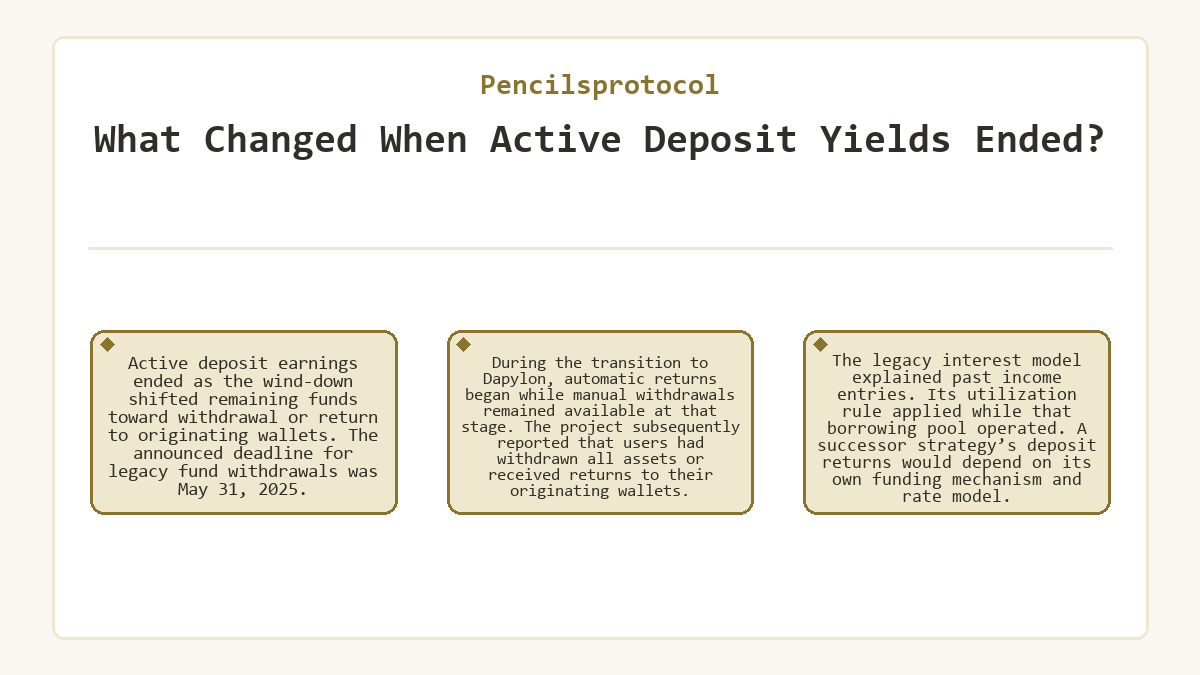
The legacy interest model explained past income entries. Its utilization rule applied while that borrowing pool operated. A successor strategy’s deposit returns would depend on its own funding mechanism and rate model.
Things people ask
Where Could Depositors Claim Legacy Interest Income?
The legacy interface placed deposit income in the "Supply & Borrow info" section. Its tutorial distinguished claiming that income from withdrawing principal through "Manage" and "Withdraw". The labels referred to different components of a deposit balance: earnings from the pool and the capital originally supplied. They described the earlier interface, before the platform ended active deposit yields.
Did a DEX Pool Fee Tier Determine the Legacy Deposit APR?
A DEX pool fee tier did not define the legacy deposit APR. The swap tutorial used a pool fee tier for liquidity provision, while the farming model adjusted deposit interest with borrowing demand and available funds. The pool fee-tier percentage therefore described a different parameter from the rate on supplied financing.
Which Asset Categories Did the Legacy deposit-pool Design Include?
The legacy farming design listed ETH-related assets, WBTC, and stablecoins among its planned deposit categories. The ETH category included native ETH, WETH, liquid staking derivatives, and liquid restaking tokens. The initial plan also named the protocol token and a Scroll token category subject to its launch. Those categories did not assign every asset the same APR or the same leveraged LP strategy.
How Did the Vaults 2.0 Restaking Plans Differ From borrower-funded Deposit Income?
The Vaults 2.0 plans proposed native restaking yield through liquid restaking integrations alongside additional token rewards. Borrower-funded deposit income came from interest paid for pool financing. Those income sources had different origins, even when the broader vault framework combined several reward types. The planned restaking expansion described a separate version; it did not establish a fixed rate for the legacy deposit pool.
Could a Returned Transfer Total Separate Principal From Earlier Interest Income?
A transfer total alone could not separate principal from any earlier interest income included in the returned assets. The wind-down concerned withdrawal or return of legacy funds after active deposit yields stopped.
Updated: