 Pencilsprotocol
Pencilsprotocol points tracked contributions as non-transferable community rewards
Pencilsprotocol points were non-transferable community rewards, called Pencils, that recorded staking and promotional contributions within Pencils Protocol. The program described launch allocations, Shop purchases, airdrop priority, and access to higher-leverage vault positions. DAPP tokens had a separate role in staking for auction quotas. These were legacy program rules: active deposit yields and Scroll Marks later stopped during the 2025 transition to Dapylon. An accumulated point balance represented participation in that earlier program, with benefits governed by its applicable terms.
Legacy Pencils recorded contributions for program benefits, while DAPP staking determined auction quotas under separate participation rules.
Staked Value and Reward Schedules
Staked asset value scaled legacy point accrual, while the applicable reward schedule supplied the time unit and asset-specific rate. The legacy hourly output schedule assigned 1 Pencil per hour for every 1,000 USDC-equivalent supplied as USDT or USDC. The schedule assigned different rates to other asset groups.
The input measured the value of eligible staked assets. The output counted Pencils over the applicable earning interval.
Community Contributions Alongside Staking
Community contributions offered another earning path through marketing campaigns and work supporting the Pencils Protocol ecosystem. The program named promotion, ambassador activity, volunteering, and partnership contributions among those routes. A staking valuation formula described the asset-based route; it did not establish an award size for promotional work. Campaign participation and ecosystem contributions therefore needed their own applicable reward terms. A historical Pencils balance could record several kinds of contributions.
Non-Transferable Rewards and Wallet Balances
Pencils represented contribution credit for benefits within the legacy reward program. Pencils were non-transferable under the legacy community point rules. This restricted movement of the points themselves, including sending them to another wallet. The property concerned the reward balance, separately from the underlying assets that a holder supplied.
A deposited balance represented supplied capital, while Pencils recorded contributions and DAPP staking served the auction participation rules.
What Did Points Change About Launch Participation?
Points were intended to give holders more favorable launch allocations and discounted quotas. The description did not give an allocation size or discount rate that applied to every launch.
Allocation Benefits
Protocol-Token Allocations
Protocol-token allocations were one intended use of Pencils as the project approached its token launch. The program planned to use points to help calculate future allocations. It did not make the point unit itself a token allocation, and the planned calculation still needed the allocation event’s terms.
Launching-Project Allocations
Launching-project allocations were a separate intended benefit for holders participating in projects launching through Pencils Protocol. The program described more favorable allocations for those holders. Each benefit concerned the launch that offered it.
Discounted Launch Quotas
Discounted launch quotas appeared alongside allocation benefits in the legacy point program. A discount concerned the participation terms for a launch; an allocation concerned the tokens that the event assigned. The separate fixed-price auction rules introduced DAPP staking as the input for acquiring auction quotas.
DAPP Staking and Auction Quotas
DAPP staking supplied the token commitment that the fixed-price auction rules used to determine quotas and allocations. Participants staked DAPP in the Staking Pool, and the committed amount influenced their allocation. Pencils served the point program’s contribution and benefit rules. Earned Pencils recorded contributions, while committed DAPP was the input for acquiring a fixed-price auction quota.
The participation rules proportionally diluted allocations when demand exceeded the pool’s available allocation. Higher DAPP commitments influenced allocation size within those rules, with oversubscription changing the final amount. A point-related launch benefit did not supply the DAPP commitment that this auction mechanism required.
A Point Calculation Beside an Auction Quota
A hypothetical historical calculation uses 2,347 USDC-equivalent in an eligible stablecoin for one eligible hour under the legacy hourly rule. At 1 Pencil per 1,000 USDC-equivalent per hour, the calculation gives 2,347 ÷ 1,000 = 2.347 Pencils for that hour.
The calculated 2.347 Pencils represented point accrual. An auction quota still required a DAPP commitment under the separate staking rules. Changing the eligible asset value or earning interval would change the calculated points. The relationship applied only while the selected hourly schedule and eligibility remained in force; it did not describe accrual after the legacy deposit operation ended.
Shop Purchases and Goods
Shop purchases were an intended redemption use for Pencils, covering items, NFTs, and virtual or physical goods. The program also named exclusive merchandise. An offering’s redemption terms would determine what a point balance could purchase. The program’s broad list of goods did not assign a single redemption price across those categories.
The early point description framed the Shop as an upcoming offering. That historical plan explained the intended connection between points and purchases without establishing present access to a catalog. A point count alone did not identify an available item, a purchase price, or completion of a redemption.
Vault Access and Airdrop Priority
Vault access and airdrop priority were point-linked benefits with different purposes in the legacy program. One concerned access to leveraged positions; the other concerned placement in an airdrop.
Access to Higher Leverage
The point program described access to higher-leverage positions as a benefit. The Vaults design separately allowed users to select leverage multiples and applied limits after evaluating borrower principal. Points concerned the access benefit, while the vault’s lending design governed the position. Borrowed funds carried interest costs, so the privilege of accessing leverage did not describe the position’s net earnings.
Priority in Airdrops
The legacy point program listed priority placements in Pencils Protocol airdrops as a benefit. Priority concerned participation in the distribution process. It did not specify a fixed token quantity for every point holder or demonstrate that a particular distribution had occurred. An airdrop’s eligibility and allocation terms determined the meaning of that priority within the event.
Scroll Rewards and the Legacy Wind-Down
Scroll rewards formed a separate incentive alongside Pencils during the legacy farming period. The farming product paired depositor income with protocol points and Scroll rewards. Later, Pencils Protocol announced that it would not participate in Scroll Session 2, ending the affected farming deposits’ eligibility for Scroll Marks. That change concerned Scroll Marks; its announcement did not specify the treatment of existing Pencils balances.
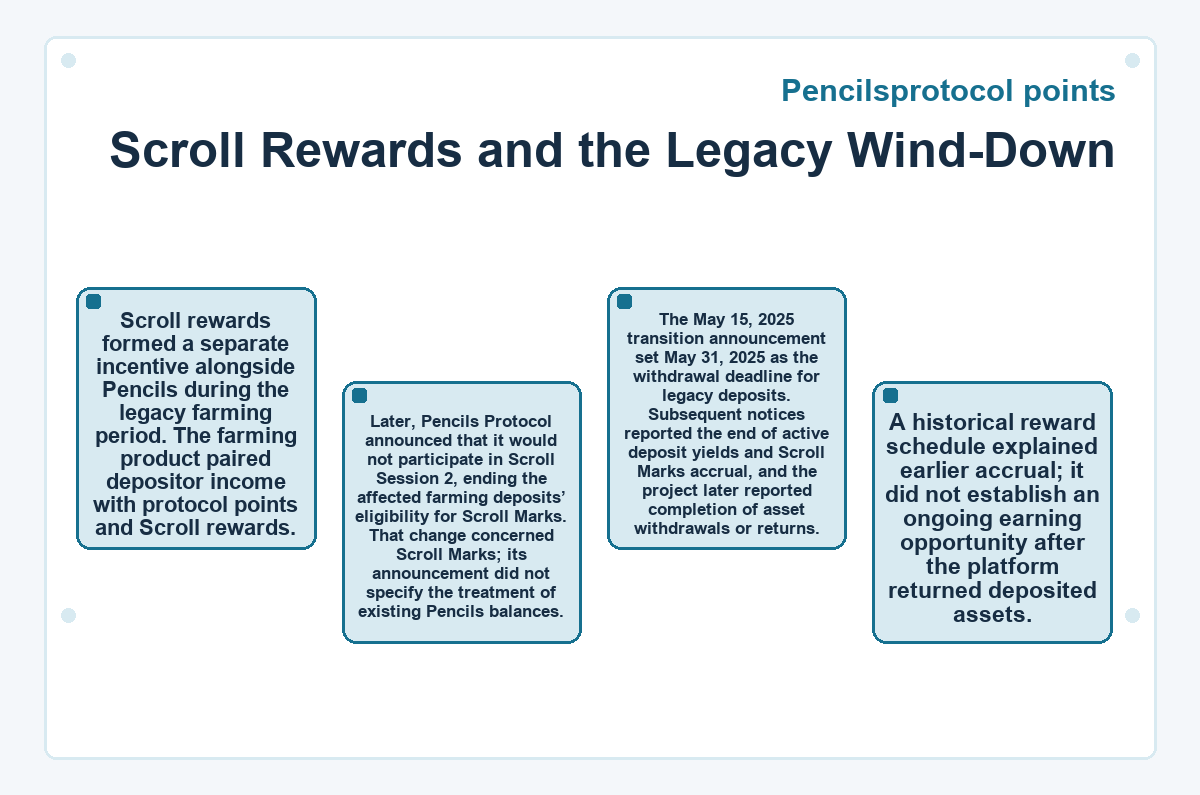
The May 15, 2025 transition announcement set May 31, 2025 as the withdrawal deadline for legacy deposits. Subsequent notices reported the end of active deposit yields and Scroll Marks accrual, and the project later reported completion of asset withdrawals or returns. A historical reward schedule explained earlier accrual; it did not establish an ongoing earning opportunity after the platform returned deposited assets.
Program Terms and Successor Benefits
Program terms governed how contribution points related to benefits, and the legacy description explicitly allowed refinement of the point program. Each launch benefit, Shop redemption, or vault-access privilege depended on the applicable program terms. The Dapylon rebrand alone did not establish equivalent benefits for a legacy Pencils balance.
Questions people ask about Pencilsprotocol points
Why Did Some Legacy Staking Descriptions Use Daily Point Rates?
The legacy documents did not explain why the quoted time units differed or establish when each schedule applied. The introductory staking description quoted 1 Pencil per 1,000 USDC-equivalent per day. The asset-specific output schedule quoted hourly rates. A daily figure and an hourly figure described different calculations, so applying the daily wording to an hourly reward interval would change the answer.
Did the USDC-equivalent Earning Basis Give Each Pencil a Dollar Price?
The USDC-equivalent basis valued the assets earning points; it did not price each Pencil. The valuation supplied the input for calculating accrual, while Pencils supplied the output unit. A redemption price or token allocation required separate program terms. Point accrual used eligible asset value, a reward rate, and an earning interval; DAPP auction quotas used committed tokens. Neither calculation established a cash redemption value for Pencils.
Does a Legacy Point Total Identify the Leverage Multiple That a Vault Allowed?
The legacy point descriptions did not map point totals to particular leverage multiples. The intended benefit concerned access to higher-leverage positions. The Vaults design separately used selectable multiples and limits related to borrower principal. A particular point balance therefore did not establish the size of a permitted position or replace the vault’s applicable borrowing constraints.
Was Returning a Deposit the Same as Redeeming Its Pencils?
Returning a deposit retrieved the underlying assets, while redeeming Pencils concerned a benefit under the point program. The withdrawal completion notice reported asset withdrawals or returns to originating wallets. It did not announce a points conversion. That asset-return status also did not establish deletion, redemption, or successor treatment of a separate legacy point balance.
Did the Scroll Session 2 Change Cancel Previously Earned Pencils?
The Scroll Session 2 farming change concerned Scroll Marks, and its announcement did not address existing Pencils balances. Pencils belonged to the protocol’s separate community point program. Ending Marks accrual therefore did not settle whether previously earned Pencils retained particular redemption benefits or received different treatment during the later transition.
How Did the May 31, 2025 Deadline Apply to Pencils?
The May 31, 2025 deadline applied to withdrawals of legacy deposited funds. The transition announcement did not identify that date as an expiry date for Pencils. A withdrawal deadline and the validity of point-program benefits concerned different rights, so that date alone could not establish how long a particular redemption benefit lasted.
Updated: